




 How to Learn Japanese Fast?">
Learning Japanese fast isn't a matter of talent — it's a matter of method. Many people start out enthusiastic, then get discouraged by the writing systems or grammar. And yet, Japanese is a consistent and logical language: once you understand its structure, progress comes quickly. That's where Global Lingua's Japanese courses come in to guide you!
Japanese is certainly more complex than Spanish or Italian for English speakers, mainly because of its three writing systems and a grammar that works very differently from English. But that complexity doesn't have to be intimidating — it demystifies quickly with the right approach. The key isn't to learn everything at once, but to focus on the actions that deliver results: understanding the writing systems from the start, speaking early, and gradually building language reflexes.
What Is the Best Way to Learn Japanese?
Set a Concrete Goal
The best way to learn Japanese is to start with a concrete goal rather than a vague program. Saying "I want to learn Japanese" isn't specific enough. But if you know why you're learning (to travel, to watch anime without subtitles, to work with Japanese partners, or to pass a language test) you can target the right topics, vocabulary, and communication situations.
Without a clear target, you spread yourself too thin. A specific goal helps you choose the right content and move forward faster. From your very first Global Lingua online lesson, your teacher will ask questions to understand your objectives and personalize your learning — with targeted vocabulary, custom exercises, and real-life scenarios.
Start with the Writing Systems
This is Japanese's first unique challenge: the language uses three writing systems at the same time.
- Hiragana (ひらがな): A syllabary of 46 characters representing the basic sounds of Japanese. This is your absolute starting point.
- Katakana (カタカナ): A second syllabary of 46 characters, used mainly for foreign loanwords (terebi for television, koohii for coffee).
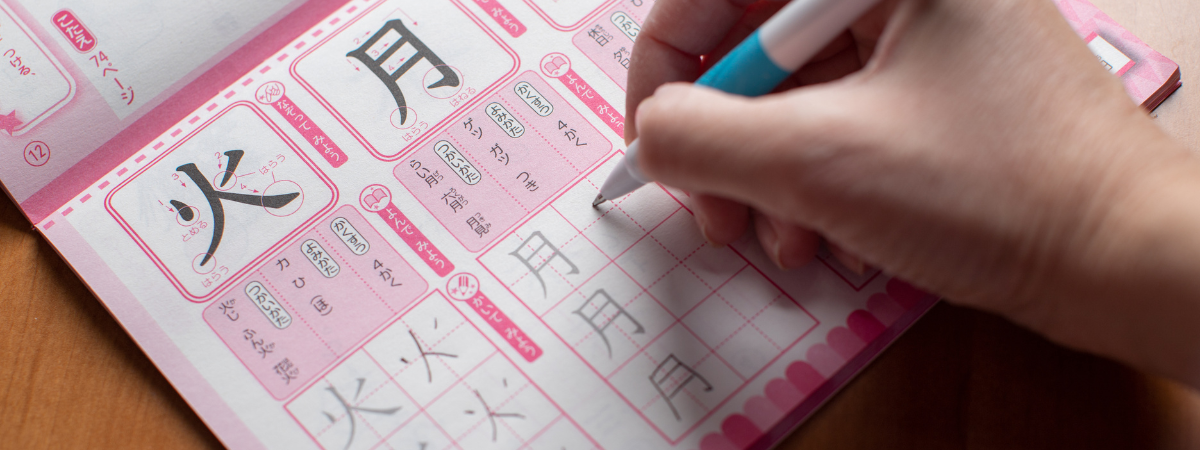
- Kanji (漢字): Logographic characters borrowed from Chinese. Everyday literacy requires around 2,000 kanji (the "joyo kanji"), but you can start speaking and reading long before mastering that many.
The good news: hiragana and katakana can be learned in 2 to 4 weeks with regular practice. Once those foundations are in place, kanji can be introduced gradually, embedded in real vocabulary as you go.
Understand Japanese Grammar
Japanese grammar is very different from English, but it is extremely regular — which is a real advantage. A few key features to know from the start:
- Word order is SOV (Subject – Object – Verb), unlike English SVO. You say the equivalent of "I sushi eat" instead of "I eat sushi."
- Particles (wa, ga, wo, ni, de…) function like prepositions and mark each word's role in the sentence. These small words are worth memorizing early, as they hold everything together.
- The verb always comes at the end of the sentence.
- There is no grammatical gender, no articles (a, the), and nouns don't change for plural. Compared to many European languages, this is a genuine simplification.
You don't need to master all of Japanese grammar before you start speaking. A few basic structures (~desu, ~masu, ~tai desu) used in real sentences are enough to get going.
Focus on Simple, Useful Vocabulary
There's no point memorizing 2,000 random words. Better to focus on everyday phrases that will actually get used: introducing yourself, ordering food, asking for directions. Target concrete topics (work, travel, family), high-frequency verbs (suru — to do, iku — to go, taberu — to eat, miru — to see, hanasu — to speak), and "function words" (particles, connectors, basic polite expressions).
One often-overlooked advantage: Japanese has borrowed extensively from English, transcribed into katakana. Words like terebi (television), pasokon (computer), resutoran (restaurant), or basu (bus) are immediately recognizable once you know katakana. This gives you a surprisingly large head start on vocabulary.
How Do You Learn Japanese Quickly?
To progress fast, you need a regular rhythm and a simple system. A short daily practice is far more effective than one long session every now and then. The goal is to build automaticity: recognizing structures, understanding by ear, and producing sentences without translating word by word.
An effective 30-minute routine looks like this:
- 5 minutes of review (hiragana, katakana, kanji, and phrases you already know)
- 10 minutes of short listening (dialogues, podcasts, clips) to train your ear
- 5 minutes of repetition out loud (shadowing / read-aloud)
- 10 minutes producing your own sentences (writing, mini dialogue, short story)
What really speeds things up is working with reusable phrases rather than isolated word lists. Instead of learning the word "eat" (taberu) on its own, learn it in context:
- Sushi wo tabetai desu. (I'd like to eat sushi.)
- Nani wo tabemashita ka? (What did you eat?)
This way, you learn the word, its pronunciation, its place in the sentence, and the particles around it — all at once.
How Do You Learn to Speak Japanese on Your Own?
Yes, learning Japanese on your own is possible. But you need to avoid the classic trap: understanding in silence without ever producing language. Speaking must become "normal" in your routine, even when you're alone.
You can practice with:
- Mini monologues (introduce yourself, describe your day, narrate an image)
- Variations on a single structure (change one element at a time — a verb, a place, a person)
- Shadowing: repeat out loud along with a native speaker to work on pronunciation and rhythm
The substitution technique is especially powerful. Keep the sentence structure and swap one element at a time — that's how you build genuine reflexes.
Watashi wa koohii wo nomimasu. (I drink coffee.)
Watashi wa ocha wo nomimasu. (I drink tea.)
Kare wa biiru wo nomimasu. (He drinks beer.)
Another Japanese-specific feature to integrate gradually: politeness levels. Everyday Japanese distinguishes a polite register (masu/desu forms) from a casual one (plain/short form). For beginners, the polite register is the right place to start — it's universally appropriate, and Japanese speakers genuinely appreciate the effort from foreign learners. The casual register can come later.
What Is the Best Tool to Learn Japanese?
The best tool depends on your goal, but one thing is certain: to progress fast, you need to combine structure and active practice. Many apps help with vocabulary or kanji memorization (Anki, WaniKani), but they're rarely enough to develop spoken fluency — they provide little feedback on oral production.
For real progress, the most effective approach combines the expertise of a teacher with the availability of a learning platform. That's where Sapere makes all the difference: between online lessons, you can do written or oral exercises, practice with conversational AI agents, and assess your level at any time.
At Global Lingua, our approach is results-oriented: we help our students learn Japanese at their own level and pace, with a clear progression and active practice that saves time. When learning reflects your actual life — your job, your travel plans, your interests — you retain more and start speaking sooner.

Mistakes That Slow You Down (and How to Avoid Them)
Some habits waste a lot of time.
Trying to master all the kanji before speaking. Kanji matter, but they shouldn't block oral practice. You can start speaking Japanese with very few kanji — hiragana and katakana are enough to get started.
Learning vocabulary in lists, without context. Every word is better learned inside a sentence, with its particle and natural position. It takes a little more effort upfront but pays off far faster in the long run.
Neglecting regularity. Thirty minutes a day beats three hours on the weekend. Japanese is built through repeated exposure: the more consistent you are, the more automatic the structures become.
Waiting until you're "good enough" to speak. Japanese people are generally very encouraging toward foreign learners and appreciate the effort, even when it's imperfect. What matters is daring to try — the occasional wrong particle or verb ending is completely fine.
Japanese builds like a habit: the more regular it is, the more natural it becomes.
Learning Japanese fast means adopting a simple, sustainable routine: hiragana and katakana from day one, vocabulary learned in context, and speaking practice from the very first weeks. With 30 minutes a day, guided practice through Global Lingua's online courses, and extra training on Sapere, real progress shows up in just a few weeks!
FAQ
Is Japanese hard to learn for English speakers?
Japanese is considered one of the most challenging languages for native English speakers, mainly due to its writing systems and very different grammar. That said, the language is highly regular and logical once the basics are in place. With the right method, progress comes much faster than most people expect.
How long does it take to speak Japanese "properly"?
With 30 minutes of practice per day and regular speaking, a beginner can hold simple conversations within a few months. Reaching a comfortable conversational level generally takes 1 to 2 years of consistent study.
Do I need to learn kanji right away?
No — not all of them. Start with hiragana and katakana (2 to 4 weeks), then introduce kanji gradually, learned through real vocabulary. Memorizing kanji out of context is inefficient.
Do I need to learn grammar from the beginning?
Yes, but in small doses — and always applied in sentences. A few basic structures (~desu, ~masu, the essential particles) are enough to start speaking. Grammar alone won't make you speak.