Reach the CLB/NCLC level your Canadian immigration project requires, with a teacher who guides you online via Google Meet.
Who is this course for?
This program is for people who need to prove their French level to Immigration, Refugees and Citizenship Canada (IRCC), the federal immigration authority. The TCF Canada is used for:
- an Express Entry profile (permanent residence outside Québec);
- other federal permanent residence programs;
- a Canadian citizenship application.
Unlike the TCF Québec, where you only take the sections your program requires, the TCF Canada covers all four skills: listening, reading, speaking and writing. Your results are then converted into NCLC levels (Niveaux de compétence linguistique canadiens, the French equivalent of the Canadian Language Benchmarks). Reaching NCLC 7 in every skill is the threshold that truly makes a difference in an Express Entry profile.
TCF Canada or TCF Québec: what's the difference?
Both tests are designed by France Éducation international and use similar question formats. What differs is who requires them, which sections are mandatory and the scale used to read your results. Before you register, check which one your program asks for.
| |
TCF Canada
|
TCF Québec
|
|
Required by
|
IRCC (federal government)
|
MIFI (Québec government)
|
|
Main use
|
Express Entry, federal permanent residence, citizenship
|
Selection by Québec (PSTQ, PEQ, CSQ)
|
|
Sections
|
All 4 are mandatory
|
Modular: only those your program requires
|
|
Results scale
|
NCLC (Canadian Language Benchmarks for French)
|
Québec French proficiency scale (Échelle québécoise)
|
|
Most common target
|
NCLC 7 in all 4 skills
|
Level 7 in listening and speaking (depending on the program)
|
|
Accepted by the other government?
|
Yes, the MIFI also accepts it
|
No, IRCC does not accept it
|
|
Validity
|
2 years
|
2 years
|
Key takeaway: if you plan to immigrate to Québec and later apply for citizenship, or if you are torn between Québec and another province, the TCF Canada is the most versatile choice, since both governments recognize it.
The exam at a glance
The TCF Canada takes about 2 hours 47 minutes and includes four sections. You can't skip any of them, so one weak skill affects your whole application.
Listening: 39 multiple-choice questions (35 min)
Reading: 39 multiple-choice questions (60 min)
Writing: 3 writing tasks (60 min)
Speaking: 3 face-to-face tasks with an examiner (12 min, including 2 min of preparation)
Results usually arrive within a few weeks, and your certificate is valid for two years. You must wait at least 20 days between two attempts, so it pays to be well prepared the first time.
What score should you aim for?
It depends on your goal. For citizenship, IRCC requires NCLC 4 in listening and speaking. For Express Entry, NCLC 7 in all four skills earns you additional points: 25 points, or 50 points if you also have at least CLB 5 in English. It also makes you eligible for invitation rounds reserved for French-speaking candidates, whose cut-off score is often much lower than in general draws.
|
NCLC level
|
Listening
|
Reading
|
Speaking
|
Writing
|
|
NCLC 4
|
331–368
|
342–374
|
4–5
|
4–5
|
|
NCLC 7
|
458–502
|
453–498
|
10–11
|
10–11
|
|
NCLC 9
|
523–548
|
524–548
|
14–15
|
14–15
|
These equivalencies are published by IRCC and may change. We recommend checking them on canada.ca before setting your target.
Program benefits
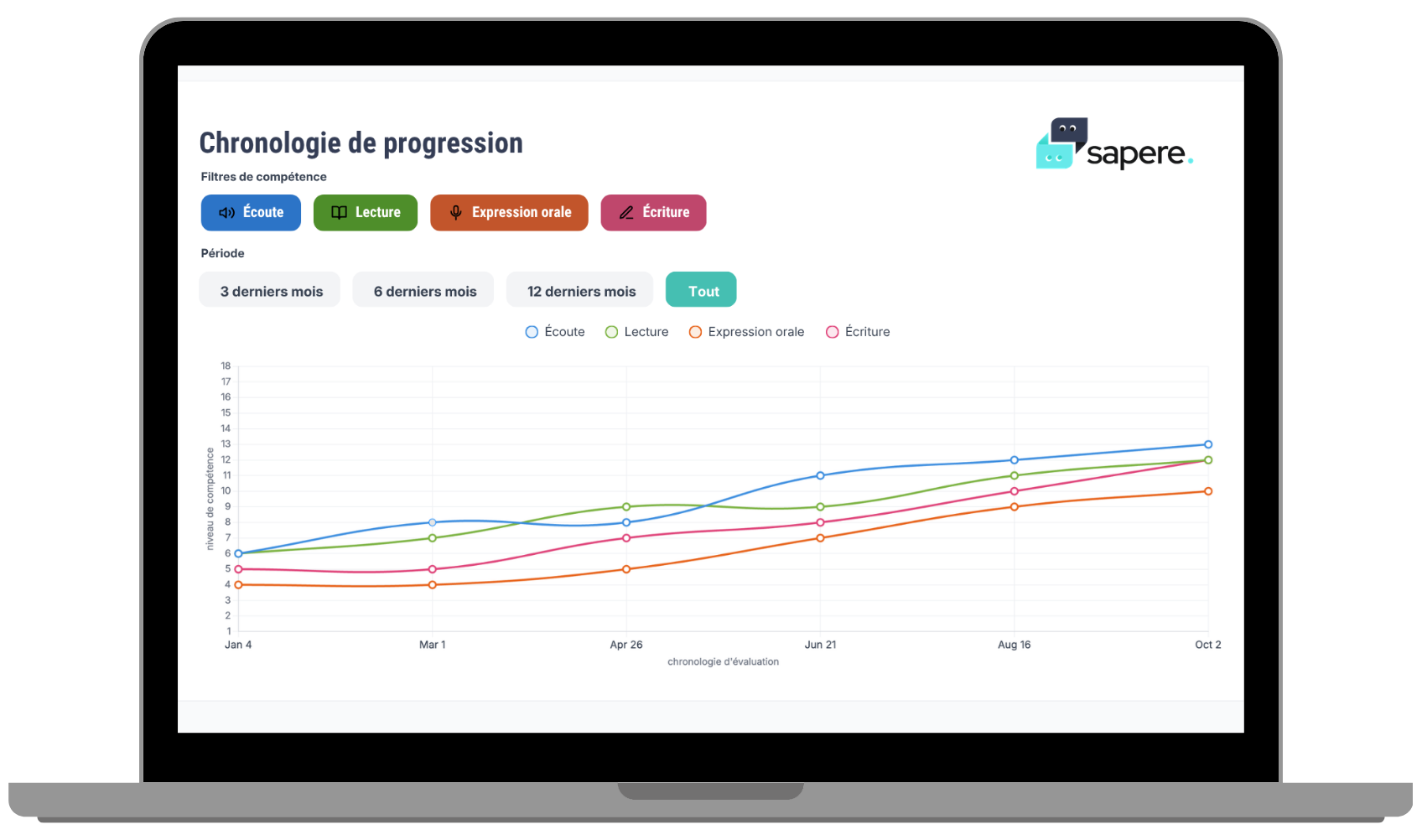
Your teacher first identifies the skill holding you back, then builds a plan with you to reach your target NCLC level in each of the four sections.
- A tailor-made program based on your starting level
- An NCLC goal set together from your very first lesson
- A pace that fits your schedule, including your exam date
- Courses for all levels, from beginner to advanced
- Regular assessments to measure your progress
- Exercises on sapere.ai between sessions
Topics covered
Content is adapted to your needs, but TCF Canada training usually covers:
- understanding a variety of audio documents: announcements, conversations, interviews;
- skimming and scanning texts of increasing difficulty;
- writing a message, an article and an argumentative text within the required word count;
- spoken interaction: introducing yourself, asking for information, defending a point of view;
- managing time and stress, section by section.
The goal: to express yourself with ease and accuracy, both orally and in writing, on exam day and after you arrive.
Teaching methods
Lessons take place online via Google Meet. You can cancel or reschedule a lesson free of charge with 48 hours' notice. You can have access to sapere.ai, our AI-powered platform for personalized exercises. On request, your teacher can provide extra exercises and full TCF Canada mock exams under real exam conditions and timing.
Lesson length
Most students start with 30-minute or one-hour sessions. As the exam approaches, many switch to longer sessions to practise a full section, such as the 60-minute writing test.