
 TCF Canada, TCF Québec or TCF ANF: Which Test Should You Take?">
Do you need to prove your French level for an immigration project, and everyone keeps telling you to take "the TCF"? Be careful: there isn't just one TCF, but several versions, each tied to a country, a government and a specific application. Choosing the wrong version means paying for a test that won't be accepted in your file.
In this article, we compare the three most searched-for versions: the TCF Canada, the TCF Québec and the TCF ANF. Good to know right away: the TCF ANF has not existed under that name since 2022. It was replaced by the TCF IRN, so that is the test we'll cover for France.
The TCF Canada: the federal gateway
The TCF Canada is required by Immigration, Refugees and Citizenship Canada (IRCC). It is mainly taken to create an Express Entry profile, for other federal permanent residence programs, or to apply for Canadian citizenship.
What sets it apart: all four sections are mandatory, for a total of about 2 hours 47 minutes.
- Listening: 39 questions (35 min)
- Reading: 39 questions (60 min)
- Writing: 3 tasks (60 min)
- Speaking: 3 tasks with an examiner (12 min)
Results are converted into NCLC levels (the French equivalent of the Canadian Language Benchmarks). Citizenship requires at least NCLC 4 in listening and speaking. For Express Entry, the level to aim for is NCLC 7 in all four skills: it earns up to 50 additional points and gives access to invitation rounds reserved for French-speaking candidates. The certificate is valid for two years.
The TCF Québec: the à la carte test
The TCF Québec is recognized by Québec's Ministère de l'Immigration, de la Francisation et de l'Intégration (MIFI). It is used by candidates for permanent selection by Québec, including the Skilled Worker Selection Program (PSTQ) and the Québec Experience Program (PEQ), when it is accepting applications. These programs lead to a Québec Selection Certificate (CSQ), then to permanent residence.
Its main difference from the TCF Canada: it is modular. You only register for the sections your program requires, which reduces both the cost and the length of the exam.
Results are not expressed in NCLC levels but on the Échelle québécoise des niveaux de compétence en français, Québec's French proficiency scale (levels 1 to 12). The most common requirement is level 7 in listening and speaking, roughly equivalent to B2, often combined with level 5 in writing. Results are valid for two years.
Note: the MIFI also accepts the TCF Canada, but not the other way around. IRCC does not recognize the TCF Québec.
The TCF ANF, now the TCF IRN: for settling in France
The TCF ANF (accès à la nationalité française) was used for French naturalization applications. On January 1, 2022, it was merged with the resident card test and replaced by the TCF IRN (Intégration, Résidence et Nationalité). This single test covers three applications in France: the multi-year residence permit, the resident card and naturalization.
Like the TCF Canada, it has four mandatory sections, but it is much shorter: about 1 hour 35 minutes in total.
- Listening: 25 questions (20 min)
- Reading: 25 questions (35 min)
- Writing: 3 tasks (30 min)
- Speaking: 3 tasks (10 min)
Results are expressed directly as CEFR levels (A1 to B2). Since France's January 2024 immigration law, the requirements have gone up:
Naturalization: B2 (B1 before)
Resident card: B1 (A2 before)
Multi-year residence permit: A2 (Nonebefore)
For naturalization, the B2 level applies to applications submitted since January 1, 2026, in both oral and written skills. The certificate is valid for two years.
The three tests at a glance
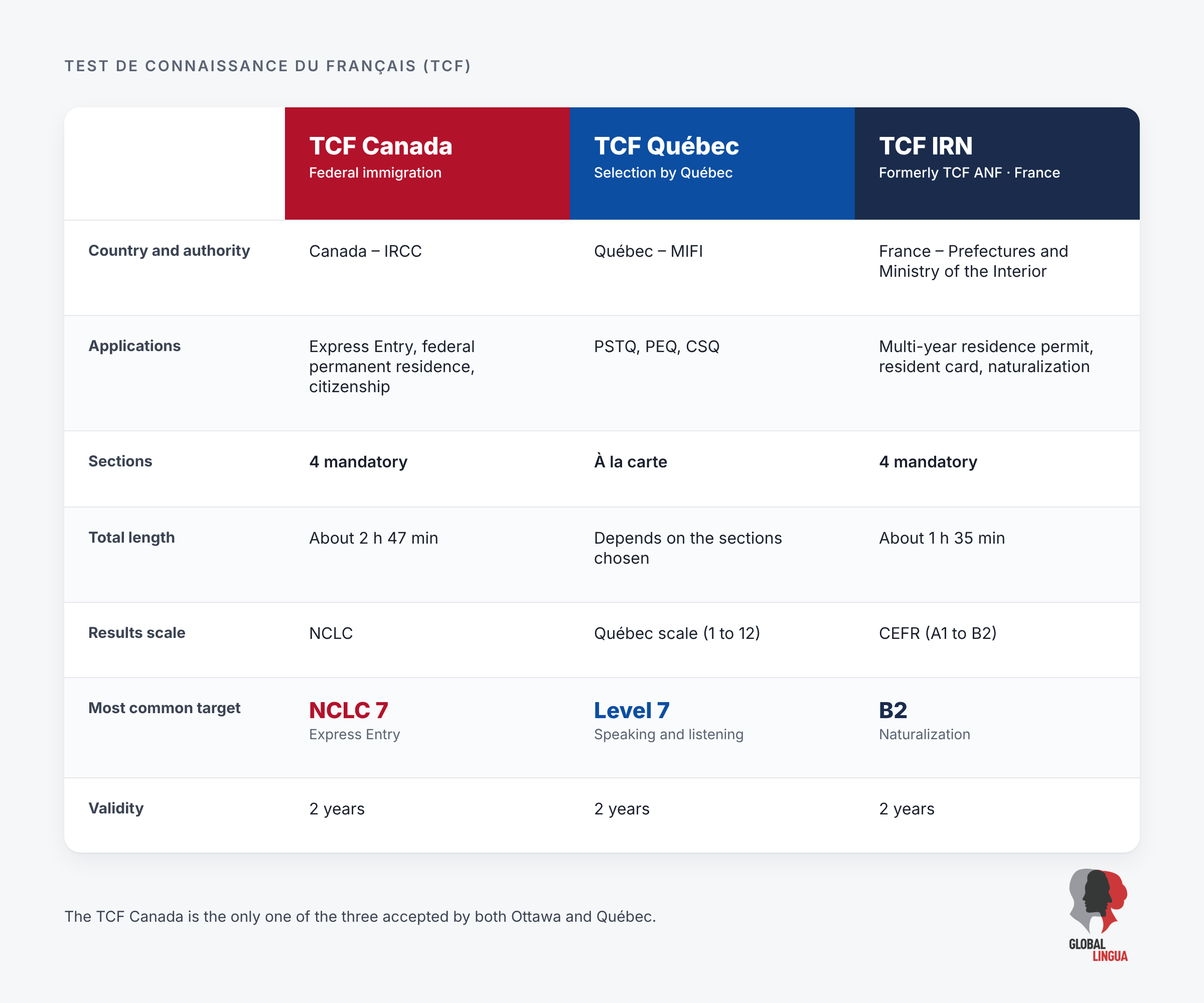
In short: your destination country determines the test, and in Canada, so does the province. The TCF Canada is the only one of the three accepted by both Ottawa and Québec. The TCF IRN is only valid for applications in France.
How to choose and prepare
Before booking a test date, ask yourself three questions:
- Which country, and which province, do I want to settle in? This determines which version of the test you need.
- Which application am I submitting? The required level varies widely from one program to another: NCLC 4 for Canadian citizenship, B2 for French nationality.
- When will I submit my application? All three certificates expire after two years. Take the test early enough to get your results on time, but not too early.
Whatever the version, all three tests use the same types of questions, designed by France Éducation international. The best preparation is to target your weakest skill, get used to the timed format and do mock exams under real conditions.
At Global Lingua, our teachers support you online via Google Meet and through sapere.ai, with a program tailored to the test and the level you are aiming for. Check out our TCF Canada Preparation and TCF Québec Preparation pages, or start with our free level test.
Government requirements change regularly. Always check the latest conditions on canada.ca, quebec.ca or service-public.fr before registering.